
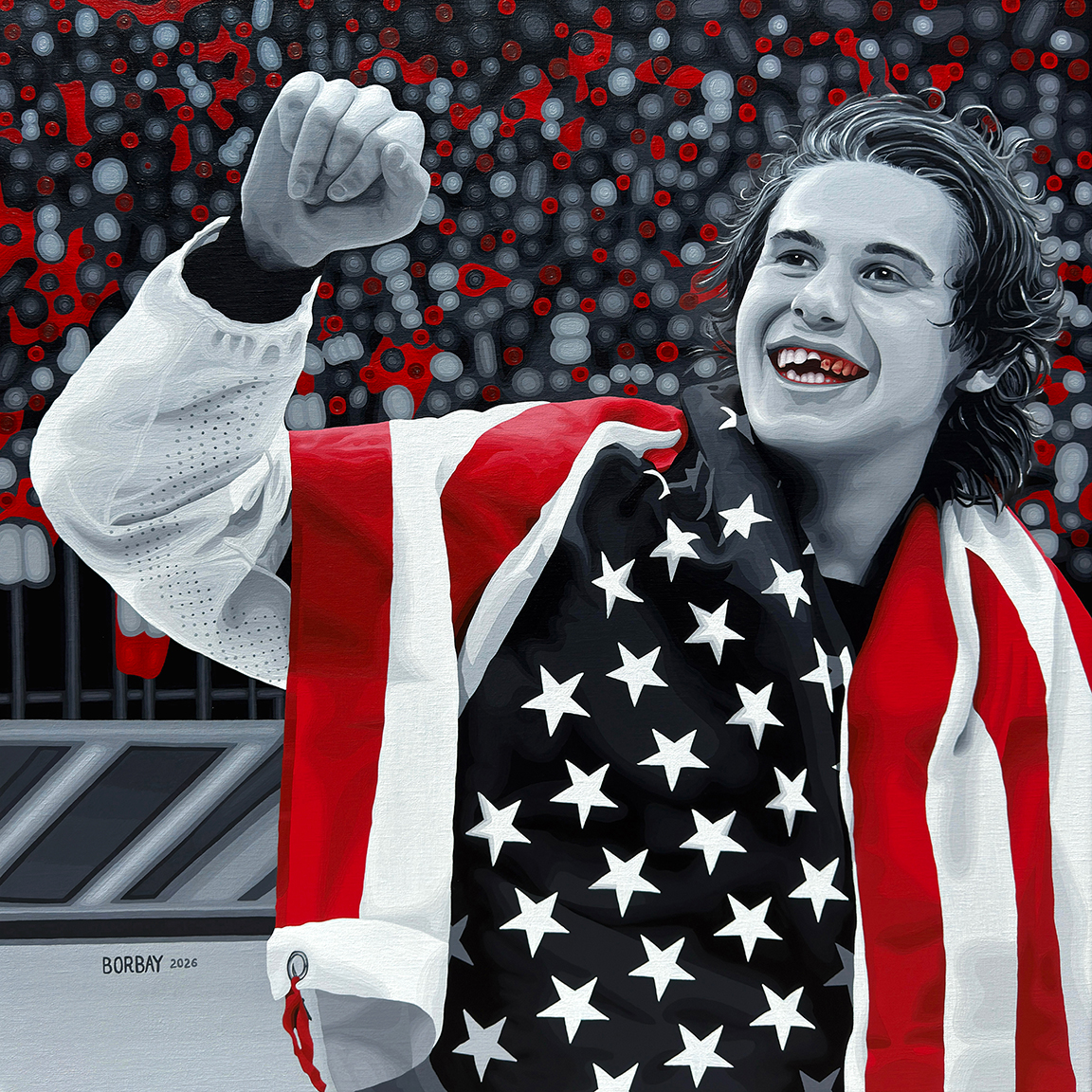
There are goals and there are moments. On February 22, 2026, Jack Hughes scored 1:41 into overtime to defeat Canada, 2–1. This victory delivered the United States its first Olympic hockey gold since Miracle on Ice.
A defensive zone poke check. One flash of speed. An incredible forecheck. A tape-to-tape pass. One perfect release.
As an American hockey player and lifelong fan, to say I was profoundly moved would be an understatement.
I grew up watching and rewatching the Miracle on Ice (“Again!”). Moreover, it was the defining American hockey story, a moment so powerful it transcended sports.
It became part of our national mythology.
Exactly 46 years later, to the day, Hughes created a new icon for American hockey: wrapped in the flag, fist raised, front teeth missing and overcome by what had just happened.
I knew immediately — I had to paint it.
A 4:00 AM PUCK DROP
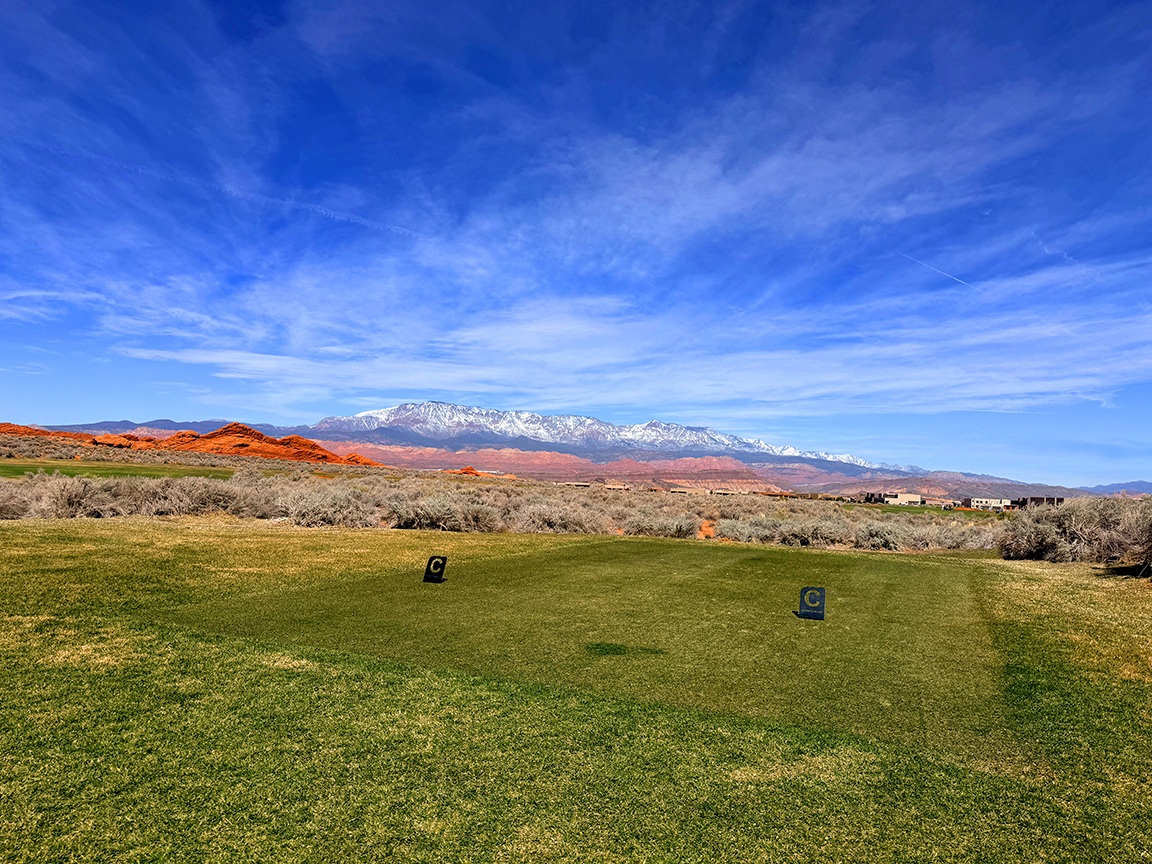
I watched the game with good friends in Mesquite, Nevada. We were scheduled to play in a pro-am golf tournament later that morning, but there was no possibility we were missing the Olympic final.
So, we got up at 4:00 AM and watched the United States play Canada for gold. The game was everything an Olympic final should be: fast, physical, tense and unbearably close. Real talk, our neighbors up North won everything but the game.
Late in the third period, Hughes draws a high sticking penalty, cracking a chiclet and drawing blood. Canada kills. Then Hughes is penalized. USA kills. Overtime. Then Hughes drives the net, receives a cherry pass from a hard fore-checking Zach Werenski and fires one through Canadian goaltender Jordan Binnington.
Gold.
The exhaustion disappeared. We shouted. We laughed. When the late, great Johnny Gaudreau’s jersey made it to the ice… I’m not ashamed to admit, there were tears.
And there was Jack… bloodied smile, American flag, gold medal, at the center of one of the greatest moments in the history of American hockey.
RED FIRST
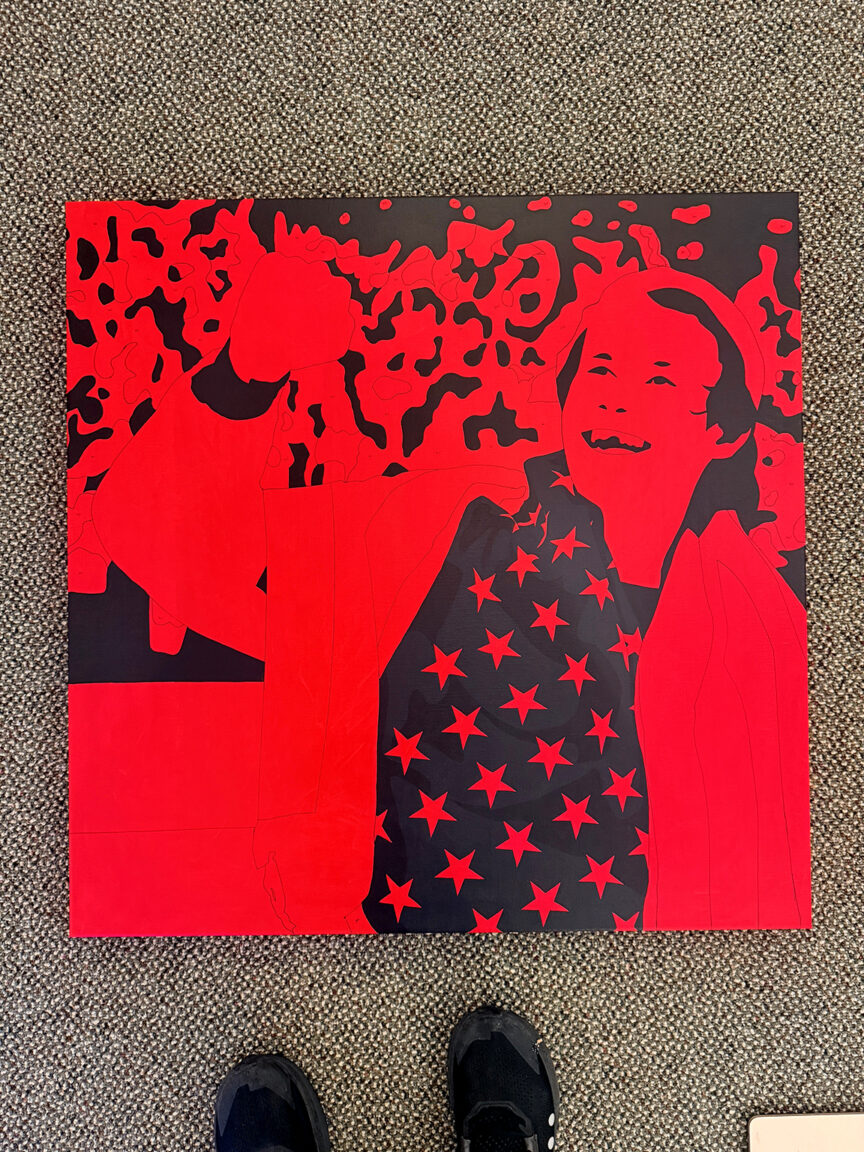
I began with a cadmium red ground and a dark compositional map. Starting aggressively immediately established the emotional temperature. Rather than slowly building toward the red, I wanted the painting to begin inside it.
At this stage, Hughes, the flag and the crowd exist as interlocking shapes. The composition is already there, but the details and the humanity have yet to arrive.
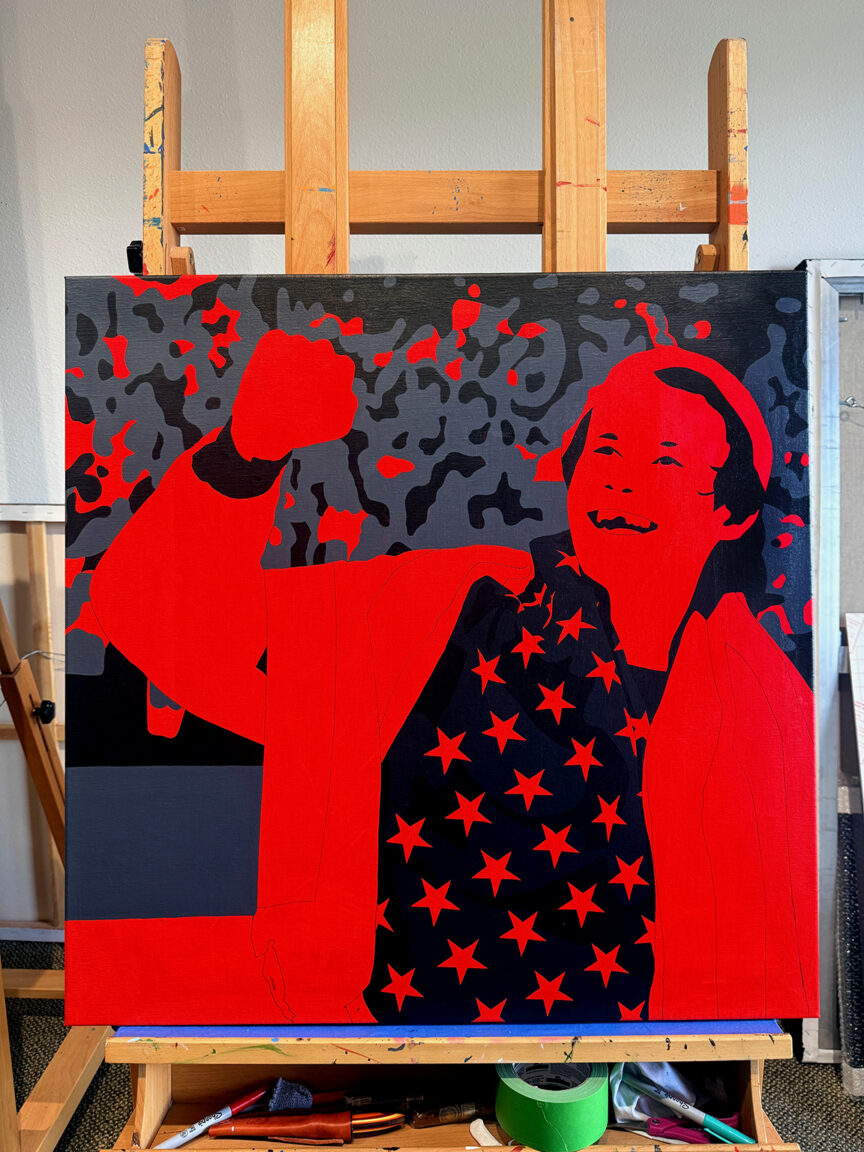
From there, I began separating the crowd into fields of black, charcoal and gray while preserving flashes of the original red.
The background needed to feel alive without becoming literal. A cosmos of spectators had to register as energy rather than individuals… a vibrating arena surrounding a singular figure.
BUILDING THE IMAGE
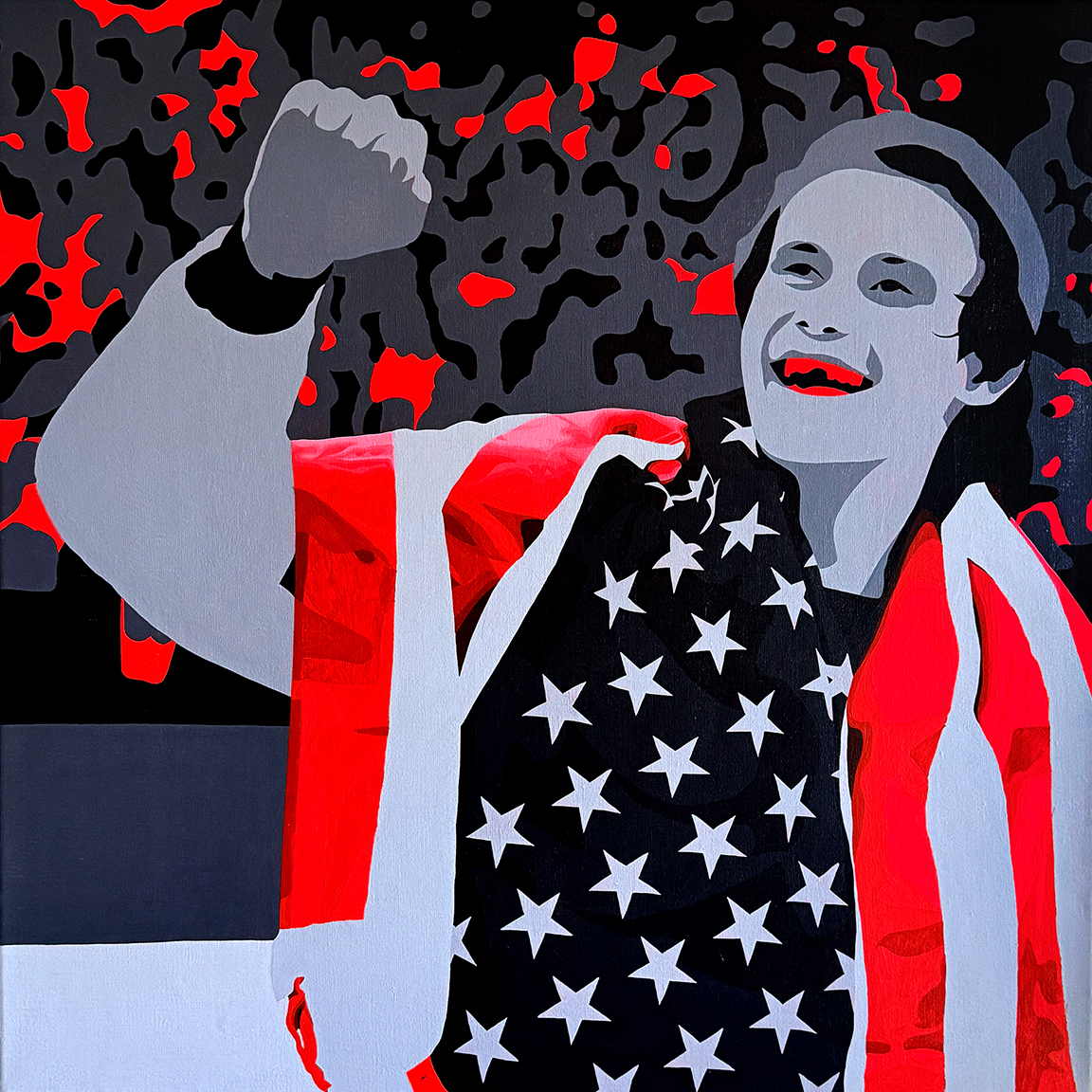
With the structure established, I introduced the first grayscale values into Hughes’s face and raised fist.
Next, I added the white stripes and stars of the flag.
This work is comprised of Titanium White, Mars Black and Cadmium Red Medium. That’s it. I resisted painting the portrait in natural color, rendering Hughes primarily in grayscale — allowing the flag and arena to carry the chromatic force.
Photographs of the moment were perfect. This was my interpretation of the moment as a hockey lover, player, and artist.
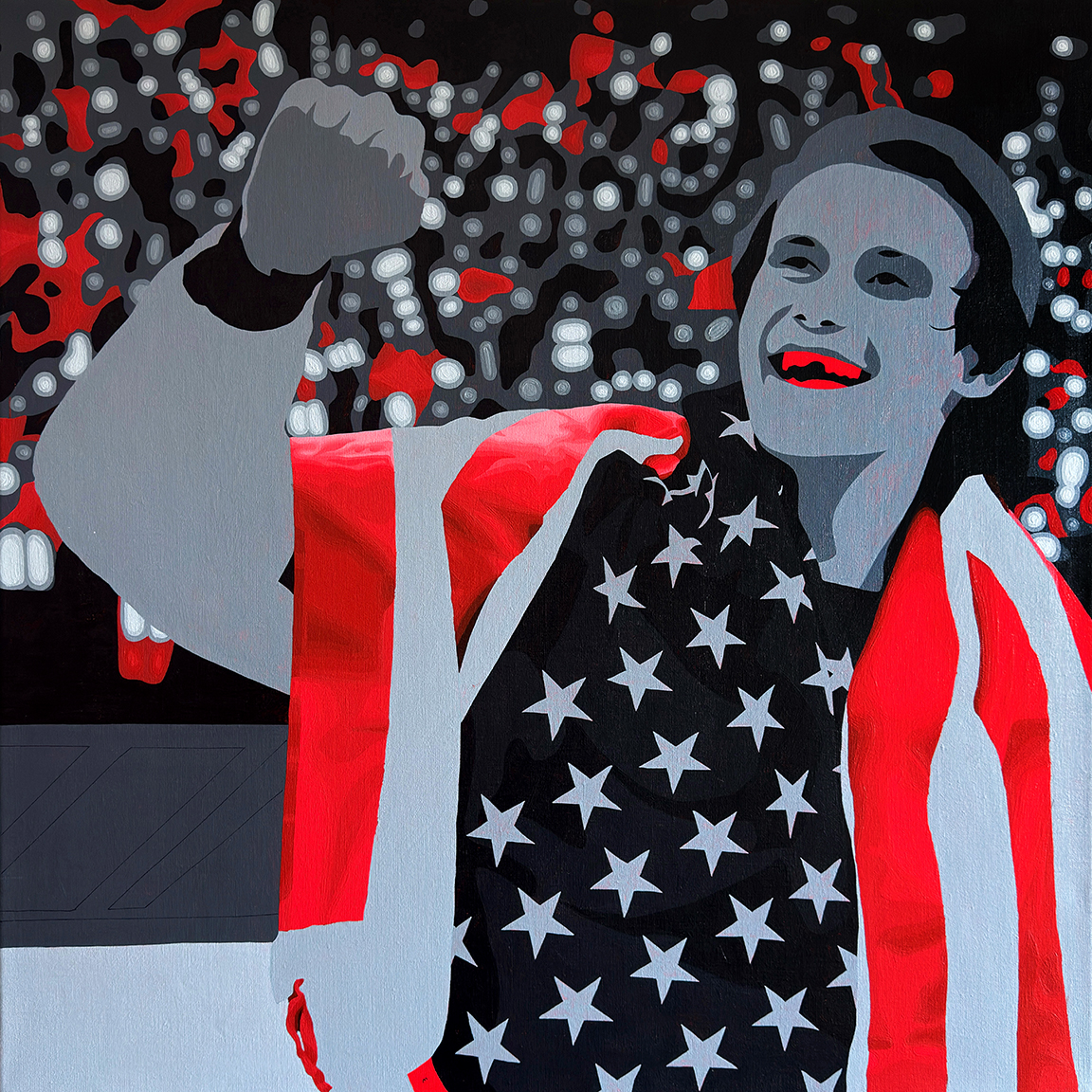
Recalling collegiate victories on the track — sweat distorts your vision, the noise becomes a din, the fans abstract into a single isomorphic shape. Moving. Abstracting.
And so, the crowd was developed through this lens —white, gray, black and red… each one adding movement and atmosphere.
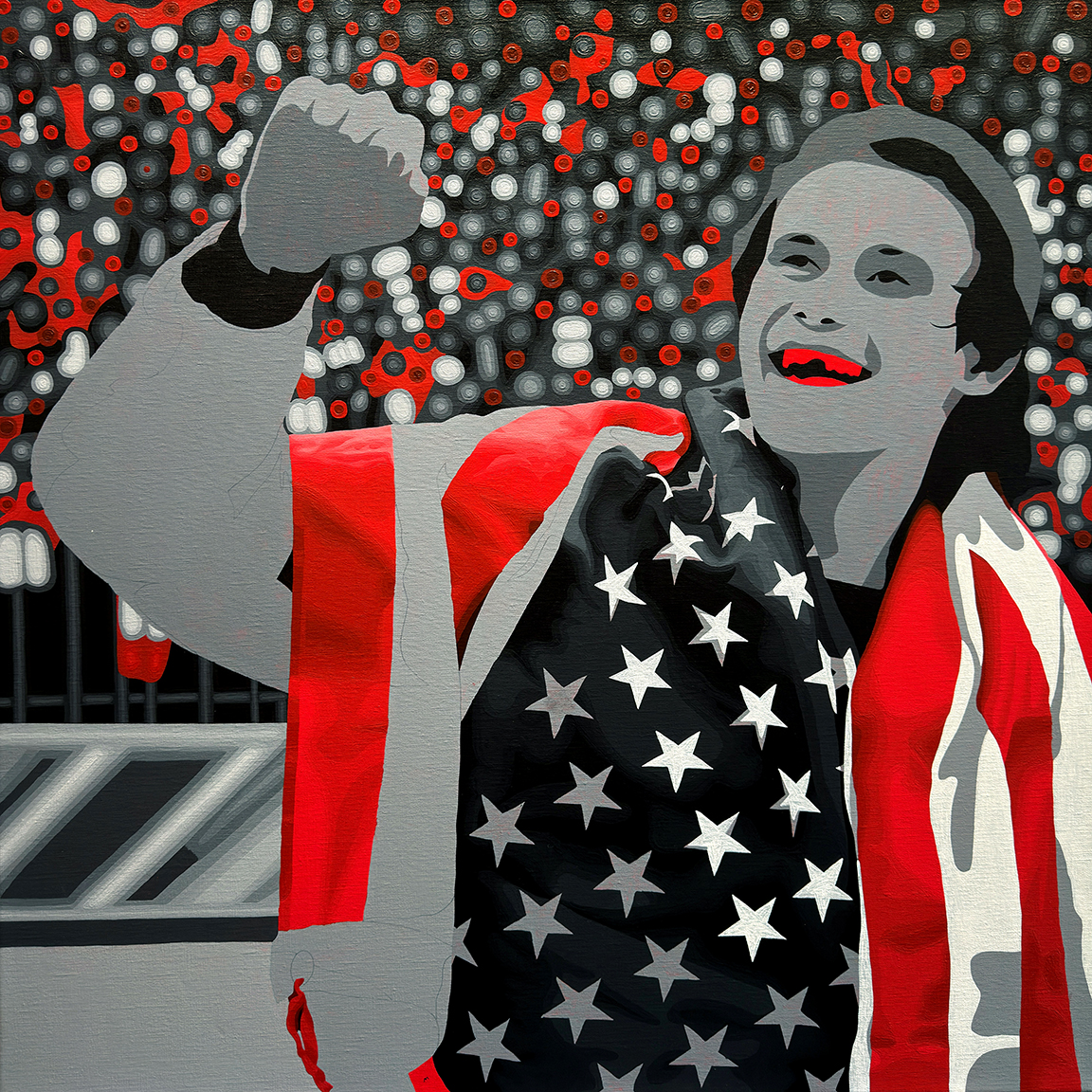
The arena continued to sharpen while Hughes remained deliberately unresolved.
This is often an important point in my process — the entire painting must begin speaking before any single passage becomes too finished. Background, figure, flag and architecture all need to advance together… the concept of “working the entire canvas at the same time”, wisdom gifted to us by the late, great Jeff Fisher at Smithtown High School.
FINDING JACK
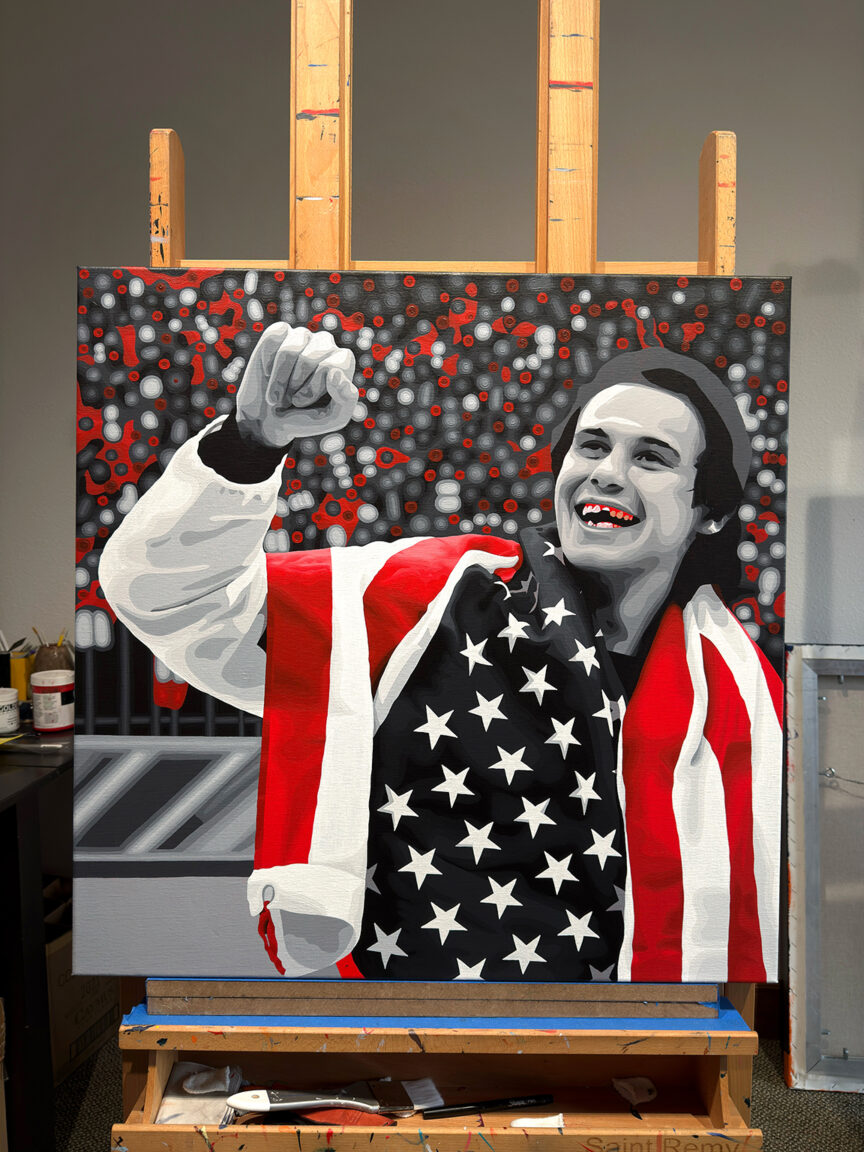
The portrait emerged through successive layers of gray.
His fist gained weight, the folds of his sleeve began to turn, the planes of his face came forward… most importantly? The expression began to feel less like an arrangement of shapes, and more like Jack Hughes.
Portraiture lives and dies in the smallest relationships…. a fraction of an inch can alter an eye, change a smile or drain the life from an expression. The challenge was not simply achieving a likeness — it was preserving the emotion.
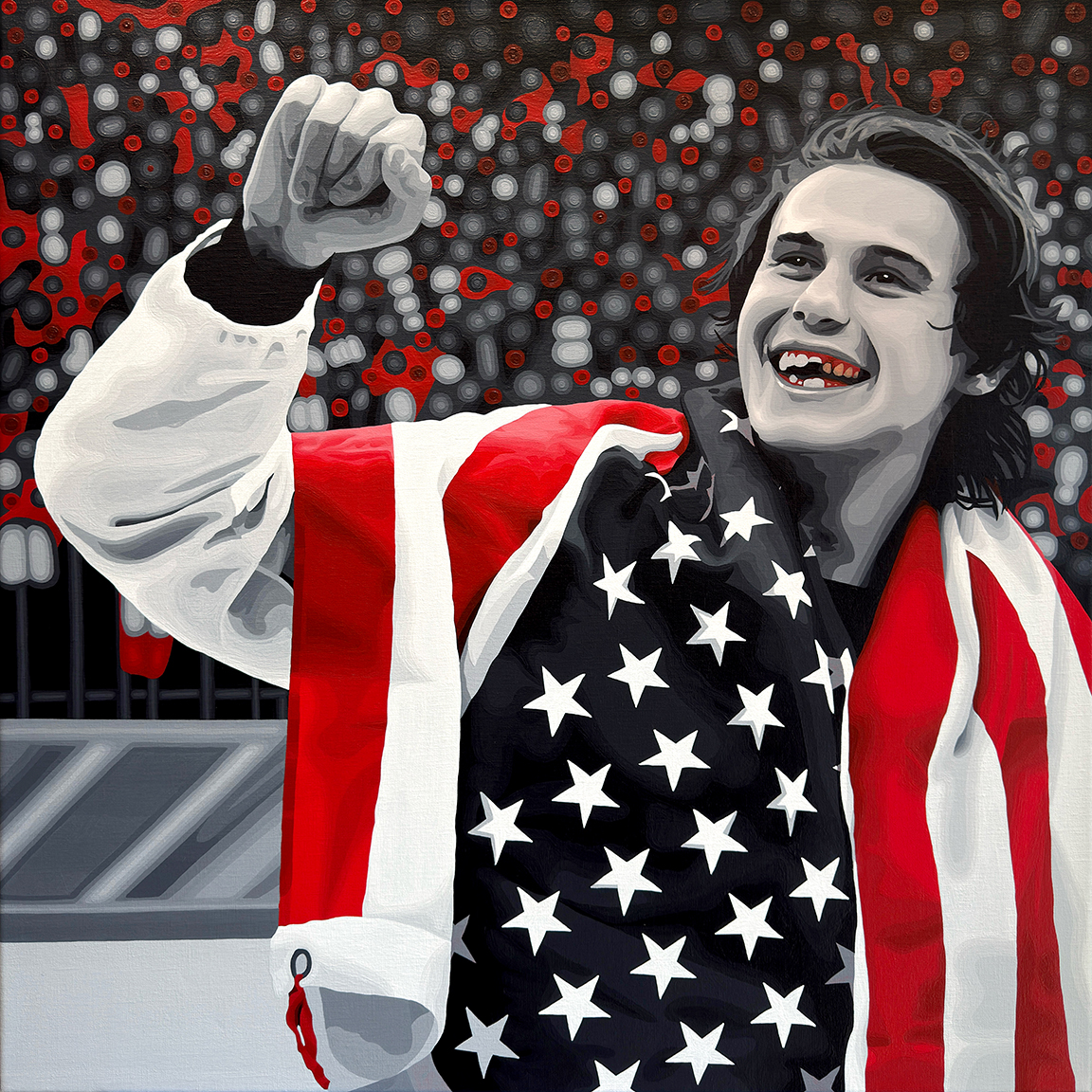
As the hair, eyes and features developed, Hughes began to separate from the atmosphere behind him.
The image found its rhythm: the vertical stripes of the flag, the constellation of white stars, the raised fist and the circular movement of the crowd.
The missing teeth were essential. In fact, I shared a late process photo with my dentist for approval — he agreed, the incisors and the canines all struck the right mark. Painting this mouth brought about a touch of PTSD. As a kid, foolishly playing without my helmet, I crashed down face first and cracked the other front tooth in half. I could feel the exposed nerves with each stroke.
This smile transforms an otherwise triumphant portrait into something unmistakably hockey. Hughes had quite literally left a piece of himself on the ice — and his chipped, bloodied smile captured the toughness and absurdity of the sport as powerfully as the raised fist captured the victory.
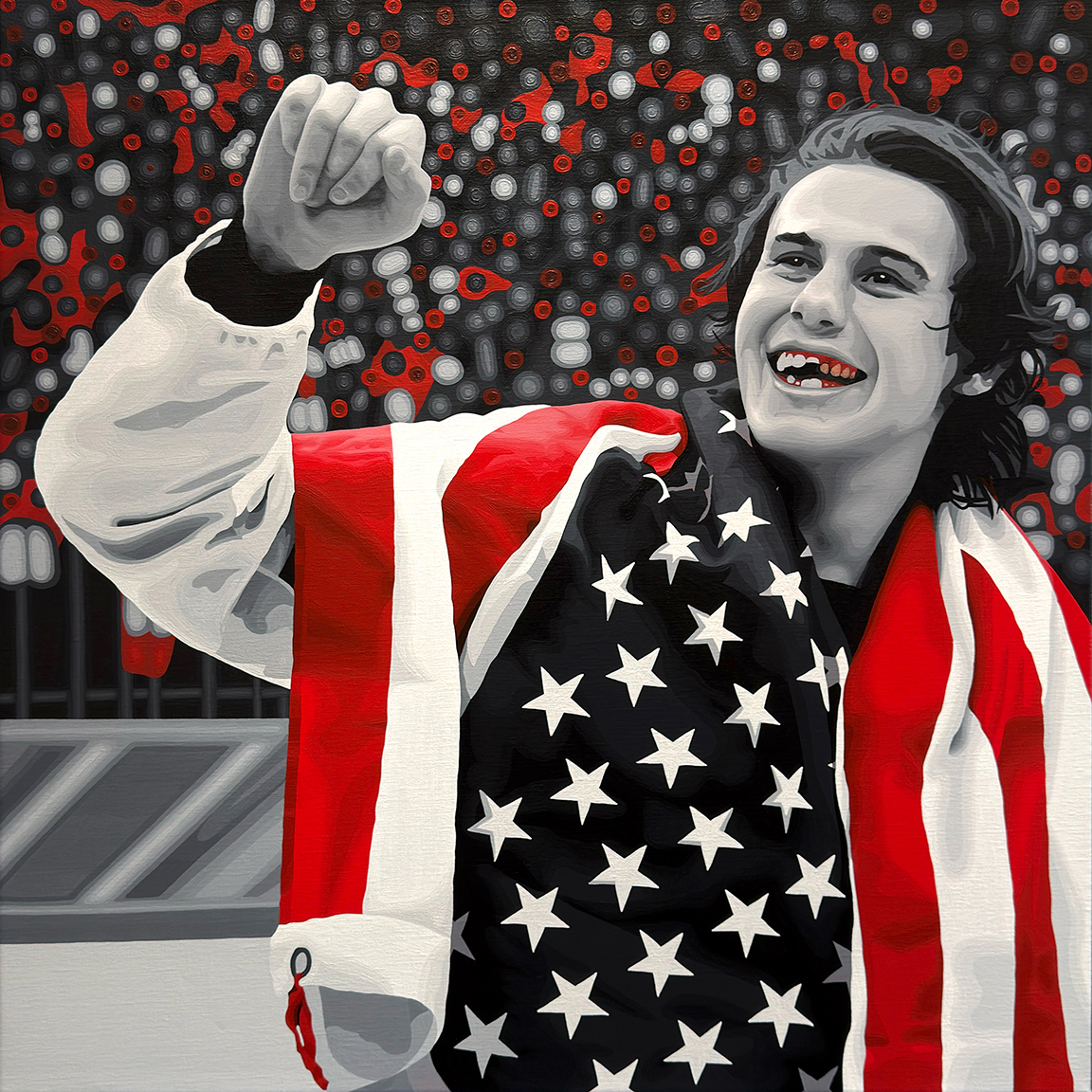
From here, the work became increasingly surgical.
I refined the hand over five days, deepened the shadows, adjusted the eyes and mouth, and continued balancing the crowd. The goal was clarity without losing the physical evidence of paint. A photograph documents the moment — a painting celebrates it.
THE FINAL SHIFT
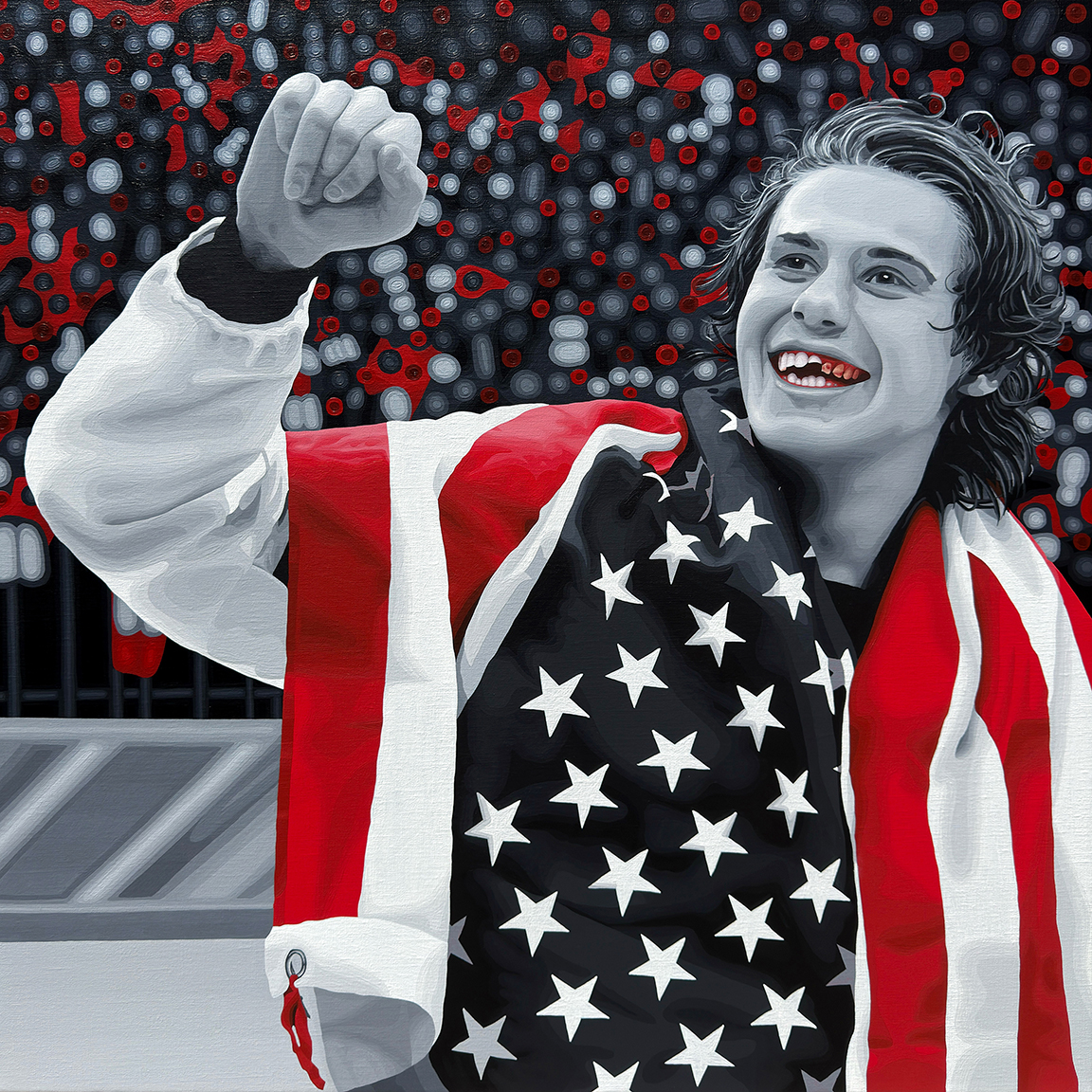
The final stage focused on Hughes’s hair, the subtle temperature shifts within his skin, the definition of his raised hand and the luminous field behind him.
Small adjustments brought the figure fully into focus. The crowd remained abstract and restless, while Hughes became clear and present at the center of everything.
The Golden Goal is about more than Jack Hughes — it’s about Team USA and an Olympic championship 46 years in the making.
It is also about what hockey can do. A game played at impossible speed can suddenly stop time. A puck crossing the line can connect generations. One golden goal can inspire another… and two teams can unite an entire hockey nation.
I grew up inspired by the Miracle on Ice. On February 22, 2026, 46 years later to the day, I experienced a new generation create its own golden moment.
The Golden Goal
Jack Hughes
30″ × 30″
Acrylic on Belgian Linen
2026
TWO GOLDEN GOALS
The men’s victory arrived a mere three days after an exceptional women’s gold-medal game between the same two countries.
On February 19th, Team USA trailed Canada late in the third period before Hilary Knight tied the game. Megan Keller then scored on a backhand 4:07 into overtime, securing a 2–1 victory and Olympic gold for the American women.
Jack and Quinn Hughes watched the game from the stands. Their mother, Ellen Weinberg-Hughes, was part of the women’s team staff as a consultant.
After scoring his own overtime winner three days later, Jack was asked who came to mind.
“Surprisingly enough, one of the first people I thought of was Megan Keller, who had the gold medal goal the other night.”
It is difficult to imagine a more meaningful expression of where American hockey stood in that moment. Two teams. Two overtime victories against Canada. Two golden goals.
For the first time in Olympic history, the United States stood atop both hockey podiums at the same Games.
HOCKEY AND ME
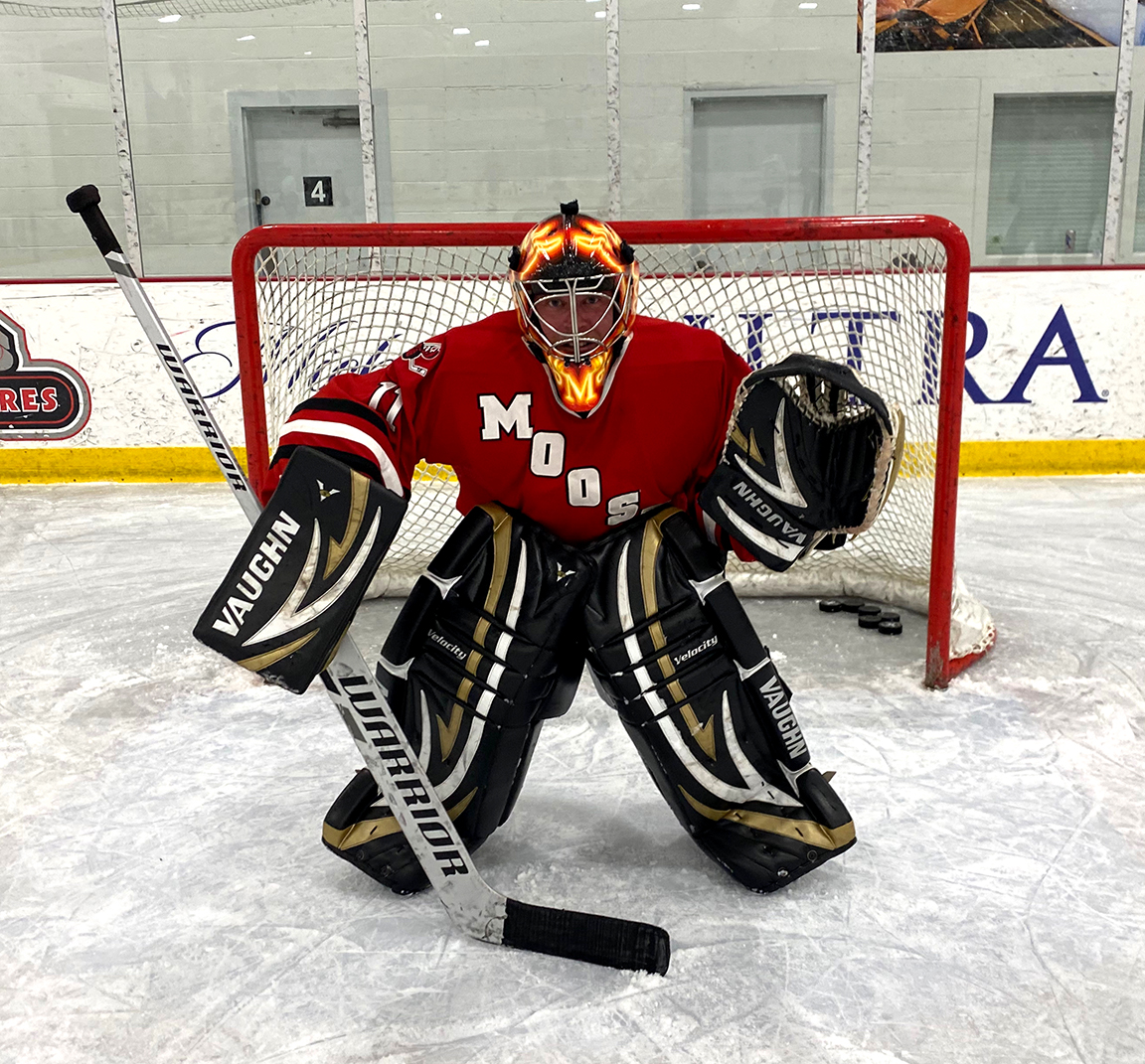
I grew up on Long Island, NY, during the roller hockey mad 90’s. My first “professional” gig was painting roller hockey goalie masks in the iconic styles of the era — Eddie the Eagle, Richter, Beezer, Brodeur… at $50 a pop, it was good money.
Once my Dad was convinced I was committed, he took me to a small shack owned by the previous equipment manager of the New York Islanders. Securing a full kit, including D&R Deer Stuffed Pillows that weighed thirty pounds a pop post-game, I found myself on the ice for the first time ever in full goalie gear at Brian Trottier’s Skating Academy in Port Washington.
There, I studied under the tutelage of goalie coach Kenny Boyce. We even scrimmaged with legends, including Kasparatis, Satan, Malakov and Hall of Famer — Pat Lafontaine. Freshman hockey at Smithtown High School paved way to Junior Varsity. The summer before Sophomore year, I found myself at a crossroad… continue to play, or hang up the pads to run. Cross Country and Track won, and I retired.
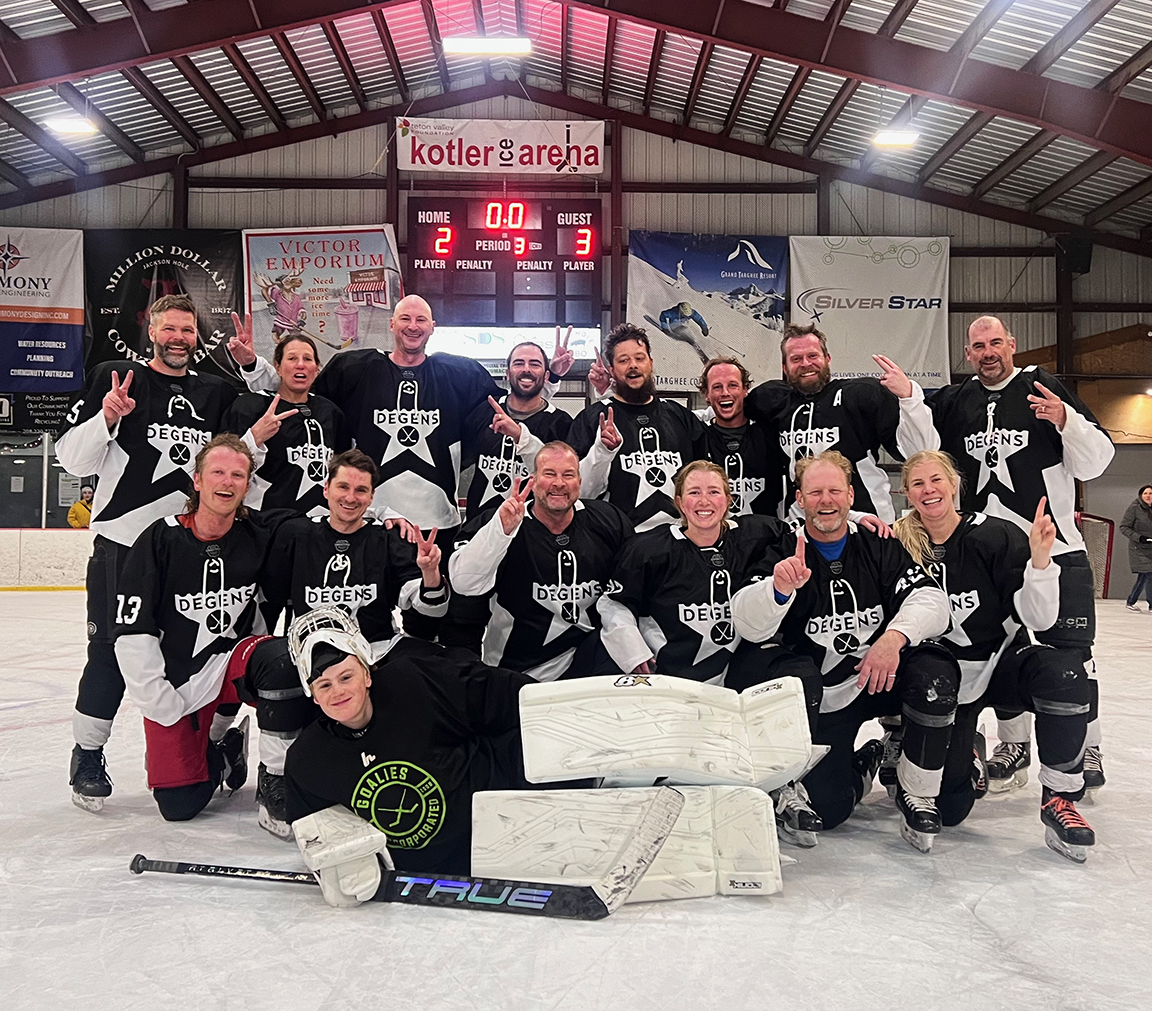
After college, I joined the Manhattan Track Club, grinding out local 5ks between many trips to the pub. Eventually, I left running in the rear view, purchased some goalies pads from the trunk of a car in Harlem, and my second hockey obsession began. I’ve been playing beer league hockey for twenty years, and hope to play for at least another twenty.
While my goaltending days are behind… hockey has given me competition, friendships and a lifelong connection to the ice. For an hour, there is nothing in the world, but a piece of vulcanized rubber, an ever ticking clock, and a battle against our opponents; most notably of late — Father Time.
A great hockey game operates on the edge of chaos. Players make instantaneous decisions while moving at impossible speeds. Space appears and vanishes. Momentum shifts with a hit (“incidental contact”), a save or a single bounce of the puck.
Then, occasionally, everything slows down… there is an opening, the puck crosses the line… time stops.
This moment reached me first as a hockey player and fan… this painting celebrates a lifelong journey, on the ice and on the easel.